
5 min read
Water is one of the most essential things we need to survive. Without it, no living thing can endure. It is something we think about every single day — yet most of us take it completely for granted.
The Savior understood this. And on a warm afternoon at a well in Samaria, He used that simple, familiar need to teach one woman — and all of us — something far more profound: that our spiritual need for Him is even greater than our physical need for water.
“Whosoever drinketh of the water that I shall give him shall never thirst; but [shall have] a well of water springing up into everlasting life.” — John 4:14
1. He Must Needs Go Through Samaria
While traveling from Judea to Galilee, Jesus passed through Samaria. This detail alone is remarkable. During the Savior's time, Jews traveling between these two regions often took a longer route to avoid passing through Samaria entirely — because of the deep hatred that existed between Jews and Samaritans. Great animosity had developed because the Samaritans had apostatized from the Israelite religion.
And yet John recorded that Jesus “must go through Samaria” (John 4:4). This was not an accident of geography. It was a deliberate choice — one that highlighted the Savior's intention for the work He would do there.
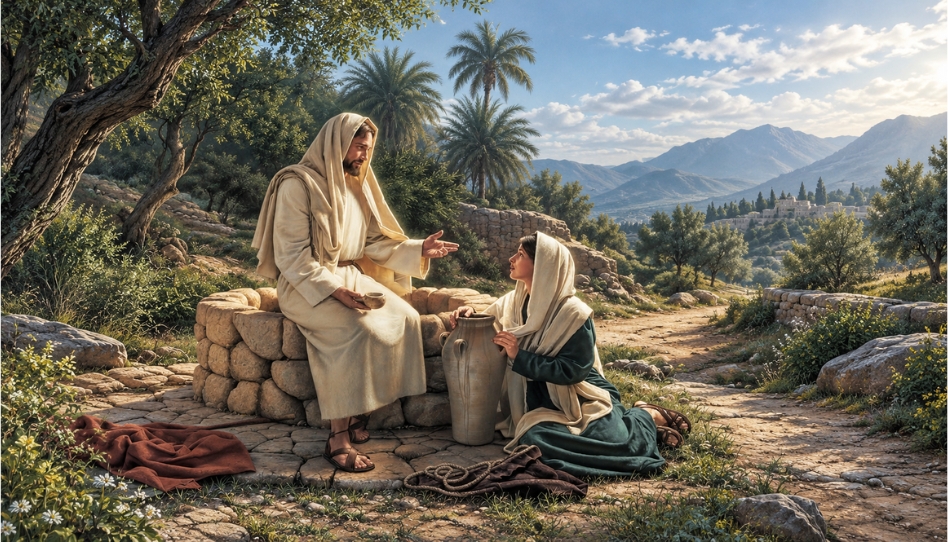
Tired and thirsty from the journey, Jesus sat down at a well in the heat of the day. While he rested there, a Samaritan woman came to draw water. What happened next would change her life forever.
“Jesus did not need to go to Samaria. The Jews of His day despised the Samaritans and traveled a road around Samaria. But Jesus chose to go there to declare before all the world for the first time that He was the promised Messiah.”
— Elder Robert C. Gay,"Taking upon Ourselves the Name of Jesus Christ,” October 2018 General Conference
2. The Encounter at the Well
When the Samaritan woman arrived at the well, she came face to face with someone she would not have expected to speak to her — a Jewish man. She was not just a Samaritan, but a woman living in sin, someone considered at that time to be the least of the least. And yet the Savior spoke to her.
He began with something familiar — water. She had come for physical water. He offered her something infinitely greater: living water.
“If thou knewest the gift of God, and who it is that saith to thee, Give me to drink; thou wouldest have asked of him, and he would have given thee living water.” — John 4:10
The living water represents Jesus Christ and His gospel. It is not something that merely quenches thirst for a moment — it becomes “a well of water springing up into everlasting life” (John 4:14). The Savior was not offering the woman a drink. He was offering her everything.
3. He Knew Her Life — and Loved Her Anyway
As their conversation continued, something remarkable happened. Jesus revealed that He knew her — not just her name, but the details of her life. He knew her sins. He knew her past. He knew the full truth of who she was (see John 4:15–26).
And he did not look down on her because of any of it. The Seminary Teacher Manual is clear on this point: the Savior knew the woman's sins but did not condemn her for them. He also helped her understand the true nature of worship — that all those who worship God in spirit and truth are accepted by Him, regardless of their race or culture.
“Christ was compassionately aware of the woman and her needs. He met the woman where she was and started by talking about something familiar and common.”
— Sister Bonnie H. Cordon, “That They May See,” April 2020 General Conference
“I believe Jesus did this so that each of us may always understand that His love is greater than our fears, our wounds, our addictions, our doubts, our temptations, our sins, our broken families, our depression and anxieties, our chronic illness, our poverty, our abuse, our despair, and our loneliness. He wants all to know there is nothing and no one He is unable to heal.”
Elder Robert C. Gay,
4. A Woman Transformed — “Come, See”

The woman who arrived at the well that day was guarded, suspicious, and weighed down by her past. Notice how she described the Savior as their conversation began — "a Jew," then "Sir," then a "prophet." But after Jesus told her He was the Messiah, everything changed.
She left her water pot behind. She ran back to the city. And she told everyone she met:
“Come, see a man, who told me all things that ever I did: is not this the Christ?” — John 4:29
Many Samaritans in the city believed because of her testimony.
“Gradually, through the conversation, she discovered Jesus Christ, and despite her past, she became an instrument of light, shining the way for others to see.” — Sister Bonnie H. Cordon
5. What This Story Means for Us
The story of the woman at the well is not simply a historical account. It is a message directed personally at each of us. The Seminary Teacher Manual invites us to ask ourselves: Do we feel as much — or more — need for Jesus Christ as we do for water in our lives?
Like the woman at the well, we all carry things — doubts, mistakes, burdens, wounds. And like her, we are not disqualified from His love because of any of them. He came through Samaria for her. He will come to us wherever we are.
“The message of the woman at the well is that He knows our life situations and that we can always walk with Him no matter where we stand.”
— Elder Robert C. Gay
The fields around us, as the Savior told His disciples, are “white already to harvest” (John 4:35). The woman who had come in shame left as a witness. When we truly encounter the living water, we cannot help but share it.
Conclusion: His Grace Is Sufficient
The Savior chose a Samaritan. He chose a woman. He chose someone living in sin. He chose the least likely person in the least likely place — to announce for the first time that He was the promised Messiah. That choice was not accidental. It was a declaration to every person who has ever felt unworthy, overlooked, or too far gone.
His grace is sufficient. His Atonement has the power to overcome any burden. And His living water — the gospel of Jesus Christ — is available to every soul who comes to the well, regardless of where they have been.
“He alone descended below all things. The power of His Atonement is the power to overcome any burden in our life.”
— Elder Robert C. Gay
You may also be interested in
- A Historic Welcome: How Indian Families Can Experience the Renovated Salt Lake Temple in 2027
- ‘Dedicate’: The New Video Series You Won’t Want to Miss
- Key Points from Saturday at October 2026 General Conference
Related video