


5mins read
There is a quiet, powerful force that can change the way you see your life not by changing your circumstances, but by changing you.
It doesn't cost money.
It doesn't require talent.
And yet most of us rarely practise it consistently.
That force is gratitude.
Gratitude is far more than good manners or polite “thank you” notes. It is a spiritual discipline — a way of seeing the world that draws us closer to God, strengthens our faith, and protects us from bitterness, resentment, and despair.
"He who receiveth all things with thankfulness shall be made glorious; and the things of this earth shall be added unto him, even an hundred fold, yea, more."
— Doctrine and Covenants 78:19
1. What Gratitude Really Is
Gratitude is a feeling of appreciation and thankfulness for the blessings we have received. But it is more than a feeling — it is an attitude we actively cultivate. It is something we work at and choose, especially when it doesn't come naturally.
President Spencer W. Kimball once observed that we thank the person who gives us a seat on a bus, the friend who pays for dinner, or the neighbour who helps us — and yet we so often forget to thank the One who gives us everything: our health, our breath, our opportunities, and our very lives.
The invitation is to slow down enough to notice. When we begin to see God's hand in ordinary moments — in the sunrise, in a kind word, in a door that opened at just the right time — something shifts inside us. We become less demanding and more appreciative. Less focused on what we lack and more amazed by what we have.
You cannot be bitter, resentful, or mean-spirited when you are grateful.
2. How to Express Gratitude to God
The scriptures invite us to thank God not occasionally, but continually.
Amulek taught:
"Worship God … and live in thanksgiving daily, for the many mercies and blessings which he doth bestow upon you."
— Alma 34:38
Not weekly.
Not only when things are going well.
Daily.
There are four practical ways to express gratitude to God:
• Acknowledge His hand in all things — every blessing has a source
• Thank Him in prayer — specifically and sincerely, not just out of habit
• Keep His commandments — obedience itself is a form of gratitude
• Serve others — when we help those around us, we honour the God who never stops helping us
We also owe a special debt of gratitude to Jesus Christ. What He suffered in Gethsemane and on the cross is a gift so vast that we can never fully comprehend it. But we can respond to it by letting it change how we live, how we treat others, and how we face our own difficulties.
Even the Saviour Himself expressed gratitude to the Father. In 3 Nephi 19, we see Jesus pausing in the middle of His ministry to give thanks. If He found it important to stop and express gratitude, how much more should we?
3. The Story of the Ten Lepers
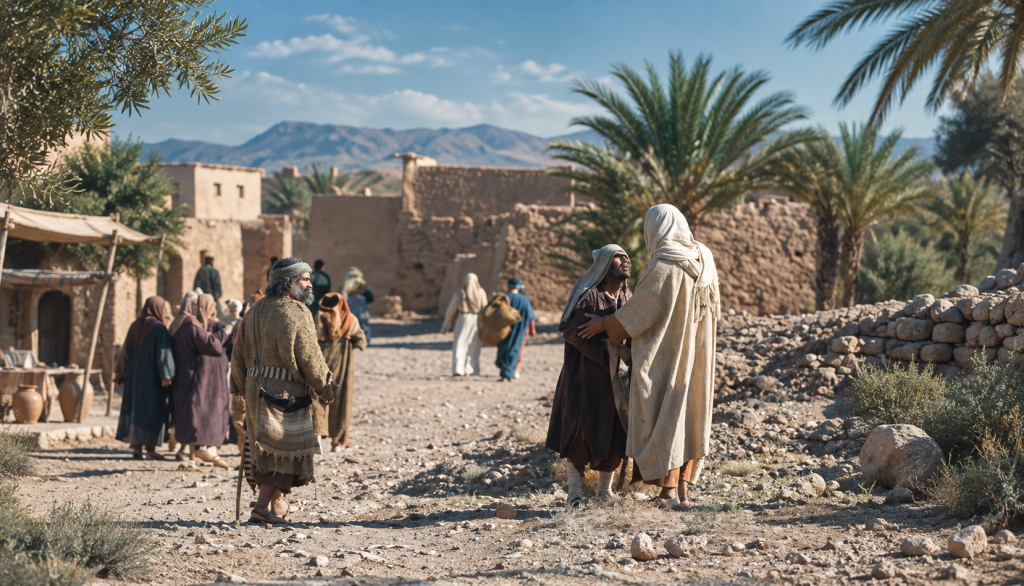
One of the most vivid pictures of gratitude — and the lack of it — comes from Luke 17.
Ten men with leprosy cried out to Jesus for healing. He healed all ten. But only one came back to thank Him.
Jesus' response is striking:
"Were there not ten cleansed? but where are the nine?"
— Luke 17:17
It was not an angry question — it was a searching one. And it is worth turning inward.
Where are we in that story? We receive healing, provision, restored relationships, quiet answered prayers — and yet how often do we go back to give thanks?
Elder Howard W. Hunter taught:
"Happiness and joy from blessings are never complete until there is a deep feeling of gratitude within oneself which moves an expression of appreciation."
___Scandinavian Area Conference, 1974
4. Grateful Even in Trials
Perhaps the most challenging and most transformative dimension of gratitude is being thankful not just for blessings, but through trials. This is where gratitude becomes truly spiritual, not merely polite.
There is a story of a teenage boy whose young sister died unexpectedly after a long illness. Their father had already passed away. In his grief and anger, the boy vowed he would never pray again. But the next morning, when his mother called the family to kneel in prayer, something remarkable happened.
His mother — heartbroken herself — knelt and began to give thanks. Not for the loss, but for the eternal ties that made the loss survivable. She thanked God for the gospel, for the promise that families are forever, and for the brief and beautiful gift their little girl had been. he taught her children the deepest truths of faith on their knees, in the worst moment of their lives.
Years later, that son then a returned missionary stood before a congregation and thanked God for a mother who was a heroine. Her gratitude in the darkest hour had saved him.
President Howard W. Hunter observed that every life has a full share of ups and downs, and many blessings do not always look or feel like blessings. Gratitude is the lens that helps us see them for what they truly are.
President Dieter F. Uchtdorf taught in his address "Grateful in Any Circumstances" that gratitude is not dependent on our situation — it is dependent on our perspective. It is a choice, made again and again, to look for God's hand even when it is hard to find.
5. The Gift of Expressing Gratitude to Others
Gratitude is not only something we direct toward God. It also flows between people and it changes everything it touches.
President Spencer W. Kimball was known for pausing — even in the middle of busy days — to look someone in the eyes and say sincerely: "I haven't told you lately how much I love you and appreciate you." The person who received those words said simply: "My spirit soared to a new height."
That is the power of expressed gratitude. It costs almost nothing to give and it can lift someone completely. People around us do better, feel more confident, and give more generously when they know their efforts are seen and valued.
Think of the parents who go unnoticed.
The teacher who never hears that they made a difference.
The friend who showed up in a hard season and never received a word of thanks.
Expressing gratitude to them is not just courtesy — it is love in action.
6. Teaching Gratitude in the Home

Gratitude is not just a personal virtue — it is something we pass on. If children grow up in a home where appreciation is never expressed, they may not naturally learn it anywhere else. The home is the first and most important classroom for gratitude.
A young man heading off to university left a handwritten note taped inside his closet before he left. It read:
"Mom, thanks for all you’ve done to make this a special summer. You are a very special mother and I thank the Lord for the blessing of being your son. I love you and appreciate all you do in my behalf."
His mother kept that note pinned inside the closet long after he left. She said, "Every time I open this closet I read it again." A few words, written in a moment of genuine appreciation, became something she returned to again and again for strength and joy.
We build gratitude in our homes by:
• Modelling it ourselves — saying thank you sincerely and often
• • Praying with praise, not only petition — thanking God before asking for more
• Pointing out God's gifts in nature — the seasons, the stars, the flowers, the sunset
• Involving children in service — so they discover their blessings by giving to others
A young daughter once said during family prayer (as shared by President N. Eldon Tanner):
"Daddy, I don’t think we ought to ask for more blessings. The Lord has been very good to us. But I do think we should ask Him to help us to be worthy of the blessings we receive."
Conclusion: Work at Being Grateful
Gratitude is not something that happens to us when life is easy. It is something we build — slowly, deliberately, day after day.
The scriptures don’t say "feel grateful when you can." They say "live in thanksgiving daily."
That means on the hard days too. In the grief, the waiting, the uncertainty. In the season when prayers feel unanswered and blessings feel distant. Gratitude is what keeps us anchored to God when everything else feels unstable.
Start today.
Thank someone who has served you.
Notice something beautiful that God made.
Offer a prayer that asks for nothing — only thanks.
And watch what begins to change — not in your circumstances, but in you.
"Work at being grateful. You will find that it yields wonderful results."
Personal Challenge
Think of three people who have done something kind for you — a friend, a teacher, a parent, a leader.
This week, find one way to express gratitude to each of them. A handwritten note, a phone call, or a simple “thank you.”
Notice how it changes both of you.
You may also be interested in