
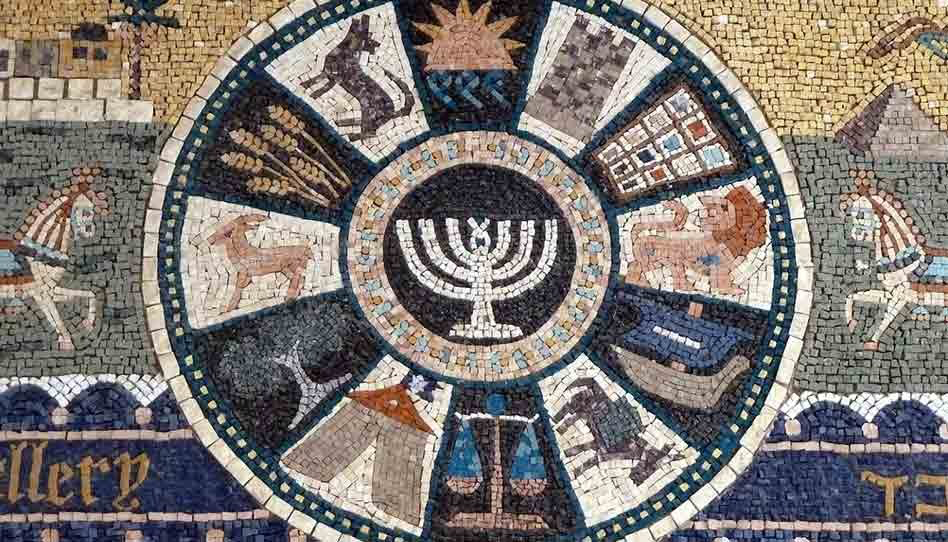
The Lord made the gospel covenant with Abraham ( see the Bible , “Abrahamic Covenant”). This covenant was renewed with Isaac and then Jacob. Jacob came to be called Israel. His sons are therefore the tribes of Israel.
He had twelve sons:
1.Reuben
2.Simeon
3.Levi
4.Judah
5.Issachar
6.Zebulun
7.Dan
8.Naphtali
9.Gad
10.Asher
11.Joseph
12.Benjamin
Each of these men formed his own family, which in time became numerous. Every Israelite, therefore, was a literal descendant of one of the twelve patriarchs.
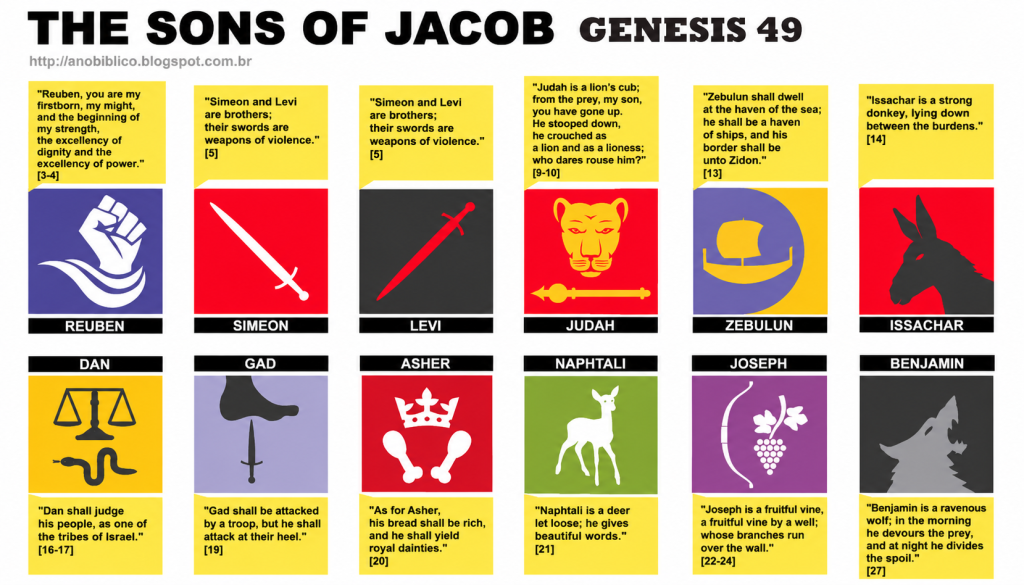
It is also important to note that before he died, Jacob adopted Joseph's sons , who were named Ephraim and Manasseh . Therefore, in most cases, during the counting of the tribes, the name of Joseph is omitted in favor of Ephraim and Manasseh.
The name of the tribe of Levi is also commonly omitted , especially when discussing land inheritance or the number of warriors, because the Levites received a special charge to serve the Lord in external ordinances. The lesser priesthood is often called the Levitical Priesthood, because they were the ones who rightfully possessed the prerogatives to perform sacrifices and administer the Temple.
Ancient Israel was scattered on not a few occasions [1]. However, the Lord promised that there would be a gathering – a reunion of all his people [2]. And this was to begin before his Second Coming.
This is why Joseph Smith received the keys of the Gathering of Israel (D&C 110:11) and wrote that Latter-day Saints believe “in the literal gathering of Israel and the restoration of the Ten Tribes” (10th Article of Faith). నియమం ) విశ్వసిస్తారని వ్రాశారు.
Physical and Spiritual Meeting
The Israelites will be gathered first spiritually and then physically or literally. One is gathered spiritually when one accepts “The Church of Jesus Christ of Latter-day Saints” and makes and keeps sacred covenants. Missionary work is the work of the Gathering.
Converts to the Church are Israelites by bloodline or adoption and belong to the family of Abraham and Jacob (see Abraham 2:9–11; Galatians 3:26–29). President Joseph Fielding Smith said:
“In the (…) Church (…) many nations are represented, (…) and these members came touched by the Spirit of the Lord, (…); receiving the spirit of gathering, they abandoned everything for the love of the gospel” (Doctrine of Salvation, vol. 3, p. 256).
The Gospel Principles manual explains:
“The physical gathering of Israel means that the Israelites will be ‘gathered into the lands of their inheritance, and established in all their lands of promise’ (2 Nephi 9:2). The tribes of Ephraim and Manasseh will be gathered in the Americas. The tribe of Judah will return to the city of Jerusalem and surrounding areas. The ten lost tribes will receive their promised blessings from the tribe of Ephraim (see D&C 133:26–34).”
When the Church was first established, the Saints were instructed to gather in Ohio, then in Missouri, and then in the Salt Lake Valley. Today, however, modern prophets have taught that Church members should build the kingdom of God in their own land. Elder Russell M. Nelson said:
“The choice to come unto Christ is not a matter of physical location, but of individual commitment. People can be ‘brought unto the knowledge of the Lord’ (3 Nephi 20:13) without leaving their homeland.”
It is true that, in the early days of the Church, conversion often also meant emigration. But now, the gathering is happening in every country. (…)
The gathering place for Brazilian Saints is in Brazil; the gathering place for Nigerian Saints is in Nigeria; the gathering place for Korean Saints is in Korea, and so forth. Zion is the 'pure in heart' (D&C 97:21).
Zion is any place where there are righteous saints (The Liahona, November 2006, p. 81).
The physical gathering of Israel will not be complete at the time of the Savior’s Second Coming, but will continue throughout the Millennium [3]. Then the Lord’s promise will be fulfilled:
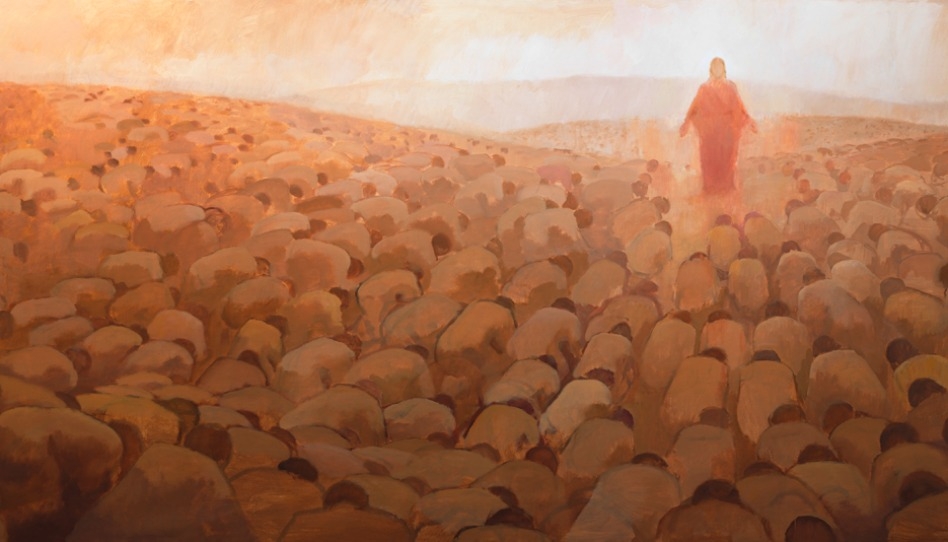
“Therefore, behold, the days are coming, declares the Lord, when it will no longer be said, ‘As surely as the Lord lives, who brought the Israelites up out of Egypt,’ but it will be said, ‘As surely as the Lord lives, who brought the Israelites up out of the land of the north and out of all the countries where he had banished them.’ For I will bring them back to their own land, the land I gave to their ancestors” (Jeremiah 16:14–15) (“The Gathering of the House of Israel,” pp. 257–258).
The Gathering does not need to be complete for the gathering of the 144,000 high priests to occur. Nor does it mean that only twelve thousand men from each tribe need to gather for Christ to come. The gathering of the 144,000, although part of the Gathering work, is not the Gathering work itself.
Something important to add is that the work of Gathering is done primarily by Ephraim, with the help of Manasseh. Most of the Church members are from Ephraim, as they are responsible for presiding over the work in the latter days. “Joseph Smith was a pure Ephraimite.” ( Discourses of Brigham Young , p. 322).
To discover which tribe a member belongs to, they can request their Patriarchal Blessing ( GEE “Patriarchal Blessings”).
Most of those who join Abraham's family are also adopted into some tribe of Israel, notwithstanding Abraham having other descendants – such as the twelve sons of Ishmael.
The Lord will grant exaltation only to those who enter into the family of Abraham (with the exception, of course, of infants who died before the age of baptism, those who lack discernment, and righteous men and women who died before the days of Abraham).
This is one of the reasons why Abraham is rightly called "the father of the faithful."
The blessings of each tribe
The following table shows the tribes of Israel with some information, including blessings unique to each. (All tribes of Israel will receive the blessings of Abraham if they are faithful, which include inheritance of certain portions of land, the opportunity to enter and belong to the Church of Christ, and promises of exaltation.)
Reuben
Meaning of the name:
"Behold! A son."
Parents
Israel and Leah.
Symbol or Insignia:
Palm tree.
Location in the Israeli camp:
South.
Blessings, Characteristics, and Responsibilities:
He would be “the most excellent in majesty and the most excellent in might,” but being “impetuous as water” meant he lost his “majesty” (Genesis 49:3-4); “Let Reuben live, and not die, and let his men not be few” (Deuteronomy 33:6).
Characters from the writings of this tribe:
Simeon
Meaning of the name:
"Listening".
Parents
Israel and Leah.
Symbol or Insignia:
Home or city.
Location in the Israeli camp:
South.
Blessings, Characteristics, and Responsibilities:
His sword is an instrument of violence (Genesis 49:5).
Characters from the writings of this tribe:
Levi
Meaning of the name:
"Together."
Parents
Israel and Leah.
Symbol or Insignia:
Tabernacle.
Location in the Israeli camp:
Around the Tabernacle, the Levites, sons of Gershon, were to the west; the sons of Merari to the north; the sons of Aaron to the east; and the sons of Kohath to the south.
Blessings, Characteristics, and Responsibilities:
His sword is an instrument of violence (Genesis 49:5); Responsibility toward the sacred – Tabernacle, Priesthood, etc. (Deuteronomy 33:8-11).
Characters from the writings of this tribe:
Characters from the writings of this tribe:
Judah
Meaning of the name:
"Praise".
Parents
Israel and Leah.
Symbol or Insignia:
Lion . .
Location in the Israeli camp:
East.
Blessings, Characteristics, and Responsibilities:
“Your brothers will praise you; your hand will be on the neck of your enemies; your father’s sons will bow down to you. Judah is a lion’s cub. You have gone up from the prey, my son. He crouches down and lies down like a lion, and like a lioness—who dares to rouse him?”
The scepter will not depart from Judah, nor the ruler’s staff from between his feet, until he to whom it belongs shall come; and the obedience of the peoples shall be his.
"He ties his donkey to the vine, his donkey's colt to the choice vine; he washes his garments in wine, his robes in the blood of grapes. His eyes will be darkened by wine, and his teeth white with milk" (Genesis 49:8-12).
Characters from the writings of this tribe:
Daniel (Daniel 1:6); David, Solomon, and the Lord Jesus Christ (Matthew 1:1-17)
Dan
Meaning of the name:
"Judge".
Parents
Israel and Bilhah.
Symbol or Insignia:
Snake.
Location in the Israeli camp:
North.
Blessings, Characteristics, and Responsibilities:
“Dan will judge his people (…) Dan will be a serpent by the roadside, a viper along the path, that bites the horse’s heels so that its rider tumbles backward. I have waited for your salvation, O Lord” (Genesis 49:16); “Dan is a lion’s cub; he leaps from Bashan” (Deuteronomy 33:22)
Characters from the writings of this tribe:
Samson (Judges 13).
Naphtali
Meaning of the name:
"Fighting."
Parents
Israel and Bilhah.
Symbol or Insignia:
Gazelle.
Location in the Israeli camp:
North.
Blessings, Characteristics, and Responsibilities:
“Naphtali is a gazelle set free; he utters beautiful words” (Genesis 49:21); “Naphtali, be satisfied with favor, and be full of the blessing of the Lord; possess the west and the south” (Deuteronomy 33:23)
Characters from the writings of this tribe:
Gad
Meaning of the name:
"Fortune".
Parents
Israel and Zilpah.
Symbol or Insignia:
Tabernacle.
Location in the Israeli camp:
North.
Blessings, Characteristics, and Responsibilities:
“As for Gad, warriors will attack him, but he, in turn, will attack them” (Genesis 49:19); “Blessed is he who enlarges Gad; he dwells like a lioness, tearing off arms and the crown of the head” (Deuteronomy 33:20)
Characters from the writings of this tribe:
Asher
Meaning of the name:
"Happy".
Parents
Israel and Zilpah.
Symbol or Insignia:
Bread, wheat, or tree.
Location in the Israeli camp:
North.
Blessings, Characteristics, and Responsibilities:
“The most excellent in majesty and the most excellent in strength” (Genesis 49:3); “Blessed be Asher among the children of Israel; let him be favored by his brothers; and let him dip his foot in oil; let your bolts be of iron and bronze; and as your days, so shall your strength be” Or in a more common version: “Blessed be Asher with his sons; let him be favored by his brothers, and let him bathe his foot in oil. Let your sandals be of iron and bronze; and let your strength be as your days” (Deuteronomy 33:24-25)
Characters from the writings of this tribe:
Issachar
Meaning of the name:
"Award".
Parents
Israel and Leah.
Symbol or Insignia:
Sun and moon or donkey.
Location in the Israeli camp:
East.
Blessings, Characteristics, and Responsibilities:
"Issachar is a strong donkey, lying down between two burdens."
He saw that rest was good, and that the land was pleasant. He bowed his shoulders to bear the burden and became a slave.” Or in a more modern version: “Issachar is a strong-boned donkey, lying down between two burdens. And he saw that rest was good, and that the land was pleasant, and he bowed his shoulder to bear the burden, and became a slave” (Genesis 49:14-15).
“Rejoice (…) in your tents” (Deuteronomy 33:18)
Characters from the writings of this tribe:
Zebulun
Meaning of the name:
"Household".
Parents
Israel and Leah.
Symbol or Insignia:
Ship or port.
Location in the Israeli camp:
East.
Blessings, Characteristics, and Responsibilities:
“Zebulun will dwell by the seashore; it will be a haven for ships; and its border will extend to Sidon” (Genesis 49:13); “Rejoice in your going out” (Deuteronomy 33:18)
Characters from the writings of this tribe:
Joseph
Meaning of the name:
"Increaser".
Parents
Israel and Rachel.
Symbol or Insignia:
Fruit-bearing branch near the spring.
Location in the Israeli camp:
Blessings, Characteristics, and Responsibilities:
“Joseph is a fruitful bough, a fruitful bough by a spring; his branches climb over a wall. The archers have bitterly attacked him; they shot at him and pursued him, but his bow remained steady, and his arms were strengthened by the hands of the Mighty One of Jacob, the Shepherd, the Rock of Israel, by the God of your father, who will help you, and by the Almighty, who will bless you with blessings of heaven above, blessings of the deep that lies beneath, blessings of the breasts and of the womb. The blessings of your father are greater than the blessings of the everlasting mountains, the desirable things of the everlasting hills; may they be on the head of Joseph, and on the crown of the head of him who was separated from his brothers” (Genesis 49:22-26); “May the Lord bless his land with the precious dew of heaven and with the waters of the deep that lies beneath, with the precious fruits of the sun and the precious produce of the months, with the precious things of the ancient mountains and the precious things of the everlasting hills, with the precious things of the earth and its fullness, and with the favor of him who dwelt in the bush. May all this come upon the head of Joseph, upon the crown of the head of him who is prince among his brothers.” (Deuteronomy 33:13-16)
“Your brothers will bow down before you, from generation to generation, to the fruit of your loins forever; For behold, you will be a light to my people [the people of Israel], to deliver them from slavery in the days of their captivity; and to bring them salvation when they are utterly bowed down under sin” (Jehovah's Witnesses, Genesis 48:11).
Characters from the writings of this tribe:
Joseph Smith Sr. and Joseph Smith Jr. (2 Nephi 3:14-15)
Benjamin
Meaning of the name:
"Son of the right hand."
Parents
Israel and Rachel.
Symbol or Insignia:
Lobe.
Location in the Israeli camp:
West.
Blessings, Characteristics, and Responsibilities:
“Benjamin is a ravenous wolf; in the morning he devours the prey, and in the evening he divides the spoil” (Genesis 49:27); “The beloved of the Lord shall dwell securely by him; and the Lord shall surround him all the day long, and he shall dwell between his shoulders” (Deuteronomy 33:12)
Characters from the writings of this tribe:
Saul (1 Samuel 9:1-2); Paul (Romans 11:1).
Manasseh
Meaning of the name:
"God has made me forget all my toil and all my father's house."
Parents
Joseph and Asenath; adopted by Jacob.
Symbol or Insignia:
Wild ox or bull.
Location in the Israeli camp:
West.
Blessings, Characteristics, and Responsibilities:
“It will become a people, and it will be great,” but it will not be greater than, nor will it be ahead of, the people of Ephraim (Genesis 48:19).
Together with Ephraim, he will "push out all the peoples to the ends of the earth" (Deuteronomy 33:17).
Characters from the writings of this tribe:
Gideon (Judges 6:15); Lehi (Alma 10:3).
Ephraim
Meaning of the name:
"God made me grow in the land of my affliction."
Parents
Joseph and Asenath; adopted by Jacob.
Symbol or Insignia:
Unicorn, Horse, or Lion.
Location in the Israeli camp:
West.
Blessings, Characteristics, and Responsibilities:
It will become a great people, it too will be great “and its descendants will be a multitude of nations” but it will not be greater nor will it be ahead of the people of Ephraim (Genesis 48:19).
Ephraim, with the help of Manasseh, “will push back all the peoples to the ends of the earth” (Deuteronomy 33:17).
Characters from the writings of this tribe:
Joseph Smith Sr. and Joseph Smith Jr. (2 Nephi 3:14-15)
NOTES
[1] The Gospel Principles manual summarizes the history of the dispersion of Israel as follows: “The Lord’s prophets often warned the house of Israel about what would happen if they fell into iniquity (…).
Despite this warning, the Israelites constantly broke God's commandments. They fought amongst themselves and split into two kingdoms: the northern kingdom, called the kingdom of Israel, and the southern kingdom, called the kingdom of Judah.
Ten of the twelve tribes of Israel lived in the northern kingdom. During a war, they were conquered by their enemies and taken into captivity, and later some fled to the northern lands and became lost to the rest of the world.
Approximately 100 years after the capture of the northern kingdom, the southern kingdom was conquered. The capital, Jerusalem, was destroyed in 586 BC, and many members of the two remaining tribes were taken captive.
Some time later, some members of these tribes returned and rebuilt Jerusalem. Shortly before Jerusalem was destroyed, Lehi and his family, who were members of the house of Israel, left the city and settled in the Americas.
After the time of Christ, Jerusalem was destroyed again, this time by Roman soldiers. The Jews were scattered throughout much of the world. Currently, Israelites are in every country in the world.
Many of them do not know that they are descendants of the ancient house of Israel” (“ The Gathering of the House of Israel ,” pp. 255–256). (Leviticus 26:33; Deuteronomy 28:25, 37, and 64; Jeremiah 29:18–19; Amos 9:9; 1 Nephi 2:4; Jacob 5)
[2] (Isaiah 5:26 and 54:7; Jeremiah 30:3; Ezekiel 28:25; 1 Nephi 15:12-17; 3 Nephi 17:4 and 21:26-29)
[3] (see Joseph Smith—Matthew 1:37)
You may also be interested in
Latter-day Saint missionaries: everything you need to know
New Guide Released to Help Members Prepare for September 6 Class Schedule Changes
Does Psalm 42 address depression? Check out the explanation.